
Rafting Bali
Complete Rafting Bali Information Guide
Rafting Bali means guided white-water trips on the Ayung River near Ubud, the Telaga Waja River in East Bali and fewer Melangit River routes in Klungkung.
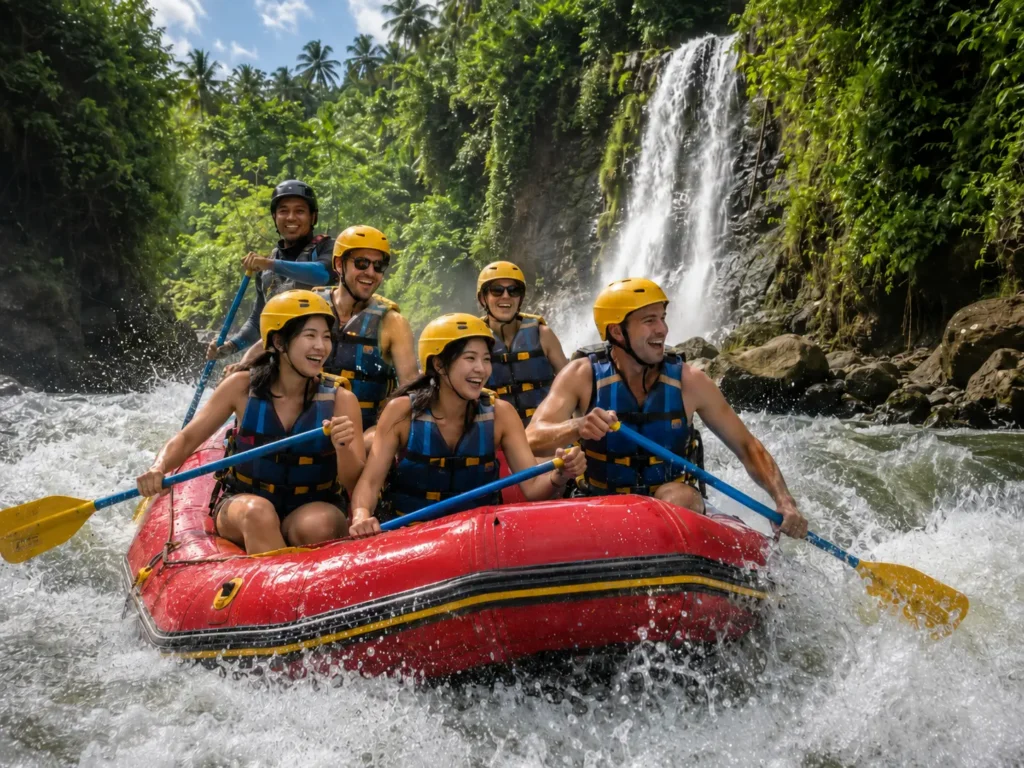
RAFTING BALI
Explore This Guide
Jump directly to the information you need.
Choosing the Right Rafting River
Ayung is usually the simplest choice for first-time visitors and Ubud plans; Telaga Waja suits those wanting a longer, more energetic run. Melangit offers a less common, shorter alternative.
Actual river time is commonly about 1½–3 hours, while a complete outing normally takes half a day or longer with transport.
This guide helps you choose between Bali’s main rafting rivers, understand realistic prices and time commitments, assess access and participation requirements, and identify what must be confirmed before paying. The decisive differences are the exact operator, route, river conditions, stair access, age policy, transport and inclusions—not simply the river name in the listing.
Rafting Bali Quick Facts
| Practical detail | What to expect |
|---|---|
| Main rivers | Ayung near Ubud; Telaga Waja in East Bali; fewer Melangit trips around Bakas in Klungkung |
| Typical river time | Ayung around 1½–2 hours; Telaga Waja around 2–3 hours; Melangit around 1¼–1½ hours, depending on route and conditions |
| Typical difficulty | Ayung commonly Class II–III; Telaga Waja commonly Class III or III+ with some products using III–IV; Melangit listings vary |
| Current price spread | Roughly IDR 250,000 for some promotional or self-arrival products to IDR 1,200,000 or more for established, premium or transfer-inclusive products |
| Experience required | Usually none for standard guided trips |
| Age rules | No Bali-wide minimum; published operator rules commonly begin around ages 5–7, while some products set higher limits |
| Swimming ability | Strong swimming is not always required, but participants should be comfortable around moving water and tell the guide if they cannot swim |
| Normal equipment | Helmet, life jacket, paddle, raft and guide; lunch, towel, showers, lockers, transfers and insurance depend on the package |
| Best time | Morning is usually easiest for traffic, temperature and weather flexibility |
| Total time needed | About 3–5 hours when self-arriving; often 5–8 hours or more with hotel transfers |
| Advance booking | Recommended for a particular river, children, groups, private transport or combination days |
Which Rafting River Is Right for You?
| If you want... | Start with... |
|---|---|
| The easiest Ubud logistics and broad beginner appeal | Ayung River |
| A longer, more energetic East Bali rafting day | Telaga Waja River |
| A shorter, less common alternative around Klungkung | Melangit River — confirm the exact operator and route carefully |
| Children or first-time rafters | Ayung River is usually the more conservative starting point, subject to operator rules and conditions |
Is Rafting in Bali Worth It?
Rafting is worth considering when you want an active group experience that combines river scenery, teamwork and manageable adventure without requiring previous rafting experience.
It is particularly suitable when:
- You want an activity rather than passive sightseeing: everyone in the raft follows commands and usually helps paddle.
- You are travelling with friends, older children or a group: the shared boat creates a more social experience than an individual ride.
- You want a practical Ubud combination: Ayung rafting can fit naturally with another central-Bali activity.
- You enjoy water, splashing and uneven movement: getting completely wet is part of the experience.
It may be better to skip when:
- You dislike losing balance or following urgent instructions: even beginner routes require attention and quick reactions.
- Stairs or steep paths are a problem: access varies greatly and some river bases involve a demanding climb.
- You have a relevant health condition: pregnancy and significant heart, back, neck, seizure, respiratory or mobility issues commonly make rafting unsuitable.
- You expect uninterrupted wilderness: popular rivers can have many rafts, photo points and commercial bases.
The value comes from the complete river experience, not from a single dramatic rapid or drop shown in advertising.
Best Rafting Rivers in Bali
Choose Ayung for the easiest Ubud logistics and broad beginner appeal; choose Telaga Waja for a longer, faster-feeling East Bali trip; choose Melangit when a shorter and less common route specifically suits your plans.
| River | Best for | Main limitation |
|---|---|---|
| Ayung | First-time rafters, Ubud plans, families and the widest operator choice | Access can involve many steps; route length, finish point and facilities vary substantially |
| Telaga Waja | Longer river time, more continuous action and an East Bali day | Longer transfer from southern resorts; grades and route descriptions differ between operators |
| Melangit | A shorter alternative around Bakas and Klungkung with fewer listings | Less product choice and less standardisation of route, facilities and published information |
UBUD RAFTING RIVER
Ayung River
Ayung is the practical default for many visitors because it is close to Ubud and has the largest range of operators. Current established products commonly provide about two hours on Class II–III water, although advertised route lengths and actual river time differ. The main decision point is often access: some bases use long stairways into or out of the valley, while selected products now advertise flatter or no-step-up exits. Confirm both the start and finish rather than assuming every Ayung trip has the same stairs.
EAST BALI RAFTING RIVER
Telaga Waja River
Telaga Waja in Karangasem is usually chosen for a longer, more energetic run. Current products advertise roughly two to three hours and routes commonly advertised around 15–18 kilometres, although operators use different sections. Sobek currently describes its route as Class III+, while other products use classifications from Class III to III–IV. Treat the operator’s current assessment and the day’s water level as more useful than one universal grade.
KLUNGKUNG RAFTING RIVER
Melangit River
Melangit around Bakas in Klungkung is a genuine rafting location but has far fewer bookable products. Current marketplace listings describe routes around 7.5–8 kilometres with roughly 75–90 minutes on the water. Select it only after confirming the exact provider, route, access, facilities, safety arrangements and transport, because the product is less standardised than Ayung or Telaga Waja.
Planning Your Rafting Trip
Choose the river, access, timing and transport around your group rather than treating every Bali rafting product as the same experience.
How Difficult Is Rafting in Bali?
Most visitor-oriented Bali rafting is accessible to beginners, but difficulty changes with the river, route, recent rainfall, water level and the guide’s judgement on the day.
River classifications are useful for broad comparison, not a guarantee of how the trip will feel. A route can become quicker and more forceful after upstream rain, while low water can expose more rocks and require additional manoeuvring.
- Ayung: commonly Class II–III and usually the gentlest default.
- Telaga Waja: commonly Class III or III+, with some products describing sections as III–IV.
- Melangit: current listings often describe Class I–III, but route information is less consistent.
- Participant effort: expect to paddle, brace your feet, sit down quickly when told and follow the guide’s commands.
A responsible operator should change, delay or cancel a trip when conditions exceed the route or group’s safe operating limits.
How Much Does Rafting Cost in Bali?
Published 2026 rafting prices span roughly IDR 250,000 to IDR 1,200,000 or more per person because the operator, residency eligibility, transfer, facilities and promotional channel can matter more than the river itself.
| Product type | Current comparison range | What may explain the difference |
|---|---|---|
| Promotional or self-arrival product | About IDR 250,000–450,000 | Limited-time marketplace rate, local operator, no hotel transfer or fewer inclusions |
| Established standard product | About IDR 400,000–800,000 | Lunch, showers, towels, lockers, established facilities and more structured operations |
| Premium or transfer-inclusive product | About IDR 795,000–1,200,000+ | Premium operator, direct published foreign-visitor rate, shared/private transport or higher service level |
| Combination day | Varies widely | Second activity, driver, pickup area, private arrangements and total programme length |
These are market indications, not fixed Bali-wide rates. Current online prices can change by date and currency, while some domestic rates are limited to Indonesian ID or KITAS holders.
- Final payable price: compare the checkout total rather than a crossed-out reference rate.
- Price eligibility: confirm whether a domestic, resident or foreign-visitor condition applies.
- Transport: determine whether pickup is private, shared, area-limited, optional or excluded.
- Inclusions: check lunch, towel, locker, shower, photographs, local fees and return transport to your vehicle.
- Insurance: ask about age limits, exclusions, excess and the conduct required for cover to apply.
How Long Does Rafting Take in Bali?
Allow at least half a day for rafting, even when the advertised river time is only 90 minutes to three hours.
| Part of the experience | Typical allowance |
|---|---|
| Registration, changing and briefing | About 20–45 minutes |
| Actual rafting | About 1¼–3 hours, depending on river and route |
| Shower, changing, lunch and waiting | About 45–90 minutes |
| Self-arrival total | Usually about 3–5 hours |
| With hotel transfers | Often 5–8 hours or more, especially from South Bali to Telaga Waja |
A listing described as a seven-hour experience may include several hours of driving. Ask for the scheduled time on the river and the estimated hotel return time separately.
When Is the Best Time for Rafting in Bali?
Morning is usually the most practical time because traffic planning is easier, temperatures are lower and there is more time to respond if river conditions change.
Rafting operates through much of the year, but a short shower at your hotel does not reveal the condition of the river. Rain upstream, the current water level, debris and visibility are more important than whether it is raining at the meeting point.
| Conditions | What may change |
|---|---|
| Drier, lower water | Slower sections, more exposed rocks and occasional pushing or extra manoeuvring |
| Normal wet conditions | Faster flow, more spray and a more energetic ride |
| Heavy upstream rain | Rapid rises, debris, reduced visibility and possible delay, rerouting or cancellation |
| Late start | Hotter conditions and a greater chance that traffic delays affect the rest of the day |
Do not pressure an operator to proceed after a safety cancellation. Confirm the rescheduling and refund policy before booking.
How Much Walking and Stair Climbing Is Involved?
Access varies by operator, and there is no reliable single stair count for Ayung, Telaga Waja or Melangit.
Ayung routes descend into a deep valley, so many bases involve substantial stairs at the start, finish or both. Other Ayung products now advertise a flatter or no-step-up exit. Telaga Waja is often marketed as having easier river access, but the exact put-in, take-out and vehicle connection still differ. Melangit listings commonly mention shorter walks, yet this must be confirmed.
Before booking, ask:
- How many steps or how many minutes of walking are there before the river?
- How many steps or how many minutes of walking are there after the river?
- Is the path steep, uneven, slippery or without handrails?
- Can someone stop or turn back if the access is unsuitable?
- Is there a vehicle connection between the finish and the changing facility?
A person may be physically capable of rafting but unable to manage the access safely. Treat the walk as part of the activity.
What Should You Wear and Bring?
Wear secure water-friendly clothing and footwear, and assume everything taken onto the raft may become wet or be lost.
Bring
- Swimwear or quick-drying clothes that stay secure in moving water.
- Secure sandals or water shoes; avoid loose flip-flops.
- A complete change of clothes, including underwear.
- A towel unless the booking clearly includes one.
- Sun protection and any permitted water bottle.
- Required medication disclosed to the operator where relevant.
- A bag for wet clothing after the activity.
Leave at the Base When Possible
- Phone and camera: a dry bag reduces water exposure but does not prevent loss or impact damage.
- Passport and large amounts of cash: do not place essential documents in unsecured storage.
- Jewellery, watches and loose sunglasses: recovery from moving water may be impossible.
- Cotton layers and heavy clothing: they become cold and cumbersome when soaked.
What Facilities Are Usually Available?
Established rafting bases usually provide changing and washing facilities, but the quality and included items vary considerably.
- Common: toilets, changing areas, showers, life jackets, helmets and paddles.
- Often included: buffet or set lunch, towel, drinking water and basic storage.
- Operator-dependent: hot showers, private changing cubicles, lockers, waterproof bags and photo services.
- Transport-dependent: parking, shuttle between base and river, hotel pickup and return to the original vehicle.
Bring your own change of clothes even when towels and showers are advertised. Confirm where valuables are stored and who controls access to that storage.
How Should You Plan Transport?
Transport must be planned around the exact operator base, not only the river name, because start points, finish points and changing facilities can be in different places.
| Arrangement | Main advantage | What to confirm |
|---|---|---|
| Self-arrival | Usually the lowest price and more control over your schedule | Exact registration point, parking, return to the vehicle and latest arrival time |
| Shared hotel transfer | Convenient for one booking and often lower cost than private transport | Pickup coverage, number of stops, waiting time and estimated return |
| Private driver | Best control for families, groups and a second activity | Whether the driver waits, follows to the finish or meets you at another base |
| Combination package transfer | One organiser coordinates the day | Actual travel between activities and whether the day is realistically paced |
Telaga Waja is a substantial journey from many southern resort areas. Ayung is easier from Ubud, but “Ubud rafting” can still refer to bases well outside central Ubud. Obtain the exact map pin before departure.
Should You Book Rafting in Advance?
Advance booking is sensible when the river, operator, pickup, child eligibility or group arrangement matters; flexible adults who self-arrive may sometimes find same-day availability.
- Book ahead for children: confirm the route, equipment fit, water-level policy and insurance before paying.
- Book ahead for groups: raft allocation, transport and lunch capacity need coordination.
- Book ahead for Telaga Waja: the longer transfer makes a mistaken meeting point more disruptive.
- Book ahead for private transport: pickup area and finish-point logistics must be agreed.
- Check weather terms: know whether an unsafe-river decision leads to rescheduling, refund or an alternative.
Do not book solely from a title such as “Ubud rafting” or “longest rafting”. Obtain written confirmation of the operator, river, start point, river time, age rule, access and complete price.
Are Rafting Combination Packages Good Value?
A combination package is worthwhile only when the second activity fits the same area, your energy level and the real transport time.
| Combination | Why it can work | What to watch |
|---|---|---|
| Ayung rafting + ATV | A natural active full-day pairing around greater Ubud and Gianyar | Two physically demanding activities, route distance and whether changing/lunch is duplicated |
| Ayung rafting + Bali Swing | A less strenuous second activity that can fit an Ubud-area day | The swing may be far from the rafting base despite both being marketed as Ubud |
| Ayung rafting + Ubud sightseeing | Practical with private transport and a restrained number of stops | Do not overload the day after stairs, wet clothing and lunch |
| Telaga Waja + Sidemen or East Bali | Geographically more sensible than returning to Ubud first | Long total day from South Bali and limited tolerance for traffic or weather delays |
Compare the actual duration of each activity rather than the total package hours. A long package can contain substantial driving, changing and waiting.
Safety & Suitability
The right rafting trip depends on swimming confidence, age, mobility, health, access and the actual river conditions on the day.
Is Rafting in Bali Suitable for Beginners?
Yes. Many Ayung and selected Telaga Waja products are designed for first-time rafters, provided participants can follow instructions and meet the operator’s age and health requirements.
A proper briefing should explain:
- Paddle commands: forward, back, stop and hold.
- Body position: where to sit, how to brace your feet and when to crouch.
- Falling out: how to float, orient your feet downstream and respond to rescue instructions.
- Raft procedures: what to do if the raft becomes stuck, turns sideways or overturns.
- Group discipline: why participants must not stand, jump or ignore the guide.
A beginner should choose the operator and access arrangement as carefully as the river. Polished facilities do not replace a clear briefing, correctly fitted equipment and attentive raft management.
Can Non-Swimmers Go Rafting in Bali?
Some operators accept non-swimmers on guided beginner routes, but this is an operator decision and must be disclosed before booking.
A life jacket provides flotation; it does not remove the possibility of entering moving water or the need to remain calm. Tell the guide clearly if you cannot swim, cannot float confidently or panic when your face goes underwater.
- Confirm acceptance in writing: do not rely on a general statement that the activity is beginner-friendly.
- Check the life jacket: it must fit securely and must not ride over the head.
- Choose the gentler route: Ayung is usually the more conservative default than a longer Telaga Waja product.
- Do not conceal fear or limitations: the guide needs accurate information to place and manage the group.
Is Rafting in Bali Suitable for Children?
Children can join selected rafting trips, but there is no universal Bali minimum age and operator policies commonly vary from about five or seven years upwards.
The published number is only the first screening point. The child must also fit the equipment, understand commands, tolerate cold water and sudden movement, and be covered by the operator’s insurance for that river and water level.
- Minimum age and route: ask for the rule for the exact river, not the company’s general family policy.
- Life jacket and helmet: both must fit the child correctly rather than being tightened adult equipment.
- Water-level decision: a child accepted on an ordinary day may be declined when the river is high.
- Raft placement: ask whether the child sits beside a parent and how the guide manages difficult sections.
- Access: consider the child’s ability to manage wet, steep or numerous steps after the trip.
Very young children, children unable to follow commands immediately, and anyone frightened by moving water are better suited to another activity.
Is Rafting in Bali Safe?
Rafting has genuine fall, collision, entrapment and impact risks; careful operator selection and disciplined participation reduce avoidable danger but cannot remove it.
Before entering the river, check for:
- Correctly fitted equipment: helmet, life jacket and paddle appropriate to the participant.
- A practical briefing: commands, recovery position, raft procedures and prohibited behaviour.
- An experienced guide: able to communicate clearly with the group and make condition-based decisions.
- Maintained equipment: raft, ropes, paddles, helmets and flotation gear in serviceable condition.
- River assessment: a credible procedure for high water, debris, lightning, poor visibility and unsafe access.
- Emergency capability: first aid, communication, evacuation arrangements and clear responsibility.
Do not participate after alcohol or drugs. Pregnant visitors and people with significant heart, back, neck, seizure, respiratory, balance or mobility conditions should normally choose another activity unless appropriately cleared and specifically accepted by the operator.
“Insurance included” is not enough information. Ask what is covered, the age limits, exclusions, excess and whether your own travel insurance covers white-water rafting.
How Do You Choose a Reliable Rafting Operator?
Choose a rafting operator by clarity, equipment, guide practice and condition-based decision-making—not by the largest discount or most dramatic photograph.
Before paying, obtain clear answers to these questions:
- Which company operates the raft, and which river section will be used?
- How long is the scheduled time on the river?
- What rapid classification does the operator use for that route today?
- What are the exact minimum and maximum ages, and can they change with water level?
- How much walking and how many stairs are involved at both ends?
- Are the helmet and life jacket available in the participant’s correct size?
- What does the operator do when upstream rain makes the river unsuitable?
- What insurance is included, and what are its exclusions and limits?
- Are lunch, towel, shower, locker, transport, taxes and local fees included?
- Who is responsible for transport from the river finish to the changing base or parked vehicle?
Be cautious when the seller cannot name the operating company, avoids stating the actual river time, or says that every participant is accepted regardless of age, health or conditions.
Frequently Asked Questions
Can a Solo Traveller Book Rafting?
Usually yes, but the operator may place you in a shared raft or require a minimum total number of participants before departure. Confirm whether the price changes when the session is quiet.
Can You Book a Private Raft?
Sometimes. “Private tour” may mean private transport rather than exclusive use of the raft. Ask whether only your party will be in the boat, how many guides are assigned and whether a minimum charge applies.
Is the Telaga Waja Dam Drop Included?
Not every Telaga Waja booking uses the same section or operational decision. Confirm whether the advertised drop is part of the exact route and whether it can be bypassed or removed when conditions require.
Can You Take a Phone or Camera on the Raft?
It is safer to leave valuables in secure storage. A waterproof bag can reduce water exposure but cannot prevent loss, crushing or impact. Some operators photograph the route and sell images afterwards.
Does Rafting Usually Include Lunch?
Many established packages include a simple buffet or set meal after rafting, but this is not universal. Confirm dietary options, drinking water and whether lunch is included in the final price.
Should You Tip the Rafting Guide?
Tipping is optional rather than a fixed participation charge. Give only what you consider appropriate for good service, and do not treat pressure for a particular amount as part of the published price.
Related Experiences
Choose ATV riding when you want individual vehicle control, mud and off-road terrain. It is one of the easiest active experiences to combine with Ayung rafting around greater Ubud.
Choose a swing experience when you want a shorter, less physically demanding activity after rafting. Confirm the exact venue because “Ubud” products can be widely separated.
River Tubing
Choose tubing when you prefer a smaller craft and a more individual river experience. It is not automatically easier than rafting: route, water level, protective equipment and age rules still matter.
Final Advice
Choose Ayung when first-time suitability, Ubud access and broad operator choice matter most; choose Telaga Waja when a longer, more energetic run justifies the East Bali journey.
Use Melangit only after the exact product is clear. Whatever the river, confirm the operating company, current conditions, river time, access at both ends, participant eligibility, transport and complete payable price in writing.
Explore the Best Bali 4 U Network
These connected guides and planning resources are useful next steps after deciding whether rafting suits your Bali itinerary.
Questions About This Guide?
Contact the editorial team if you have a question about this guide, have noticed information that should be corrected or updated, or would like to share reliable local knowledge, suggestions or editorial feedback.